Wednesday, February 29, 2012

Why Wisconsin Needs the Special Needs Scholarship Act

The Wisconsin Special Needs Scholarship Act, Assembly Bill 110, was passed out of the Assembly Committee on Education last week on a 7-4 vote.  And the Senate Committee on Education is considering the Specials Needs Scholarship Act as well.

Successful passage and enactment of the Special Needs Scholarship Act would be just the latest in a surge of school choice programs for special needs students around the country. There are currently 10 private school choice programs across the nation for children with special needs. They operate in eight states—Arizona, Florida, Georgia, Louisiana, North Carolina, Ohio, Oklahoma, and Utah, with two programs in both Arizona and Ohio.  At the beginning of the 2011-12 school year, nearly 30,000 students were enrolled in the programs.

In the Senate hearing on Tuesday, more than 30 parents and children testified in support of this bill.  While the Committee has not yet voted on the measure, Committee members listened to more than five hours of testimony.

Just one of the many parents to testify, Sally Schaeffer, mother of Lydia, spoke at yesterday’s hearing in support of this important legislation.  Read parts of her testimony below for the inspiring story of why the Badger State needs the Special Needs Scholarship Act.

Tuesday, February 28, 2012

School Choice Mythbusters

Every day, opponents to education reform spend a lot of time, energy, and money perpetuating myths about school choice. But the reality is that not only do private school choice programs empower parents to choose the education they feel is best for their children, but they also work! 

We've compiled some of the most prevalent myths on school choice and what the facts really say about educational options:

10. School choice programs drain money from public schools

School choice programs help public schools and save money for taxpayers.  The cost of a scholarship is often less than the cost to send a student to public school.  For example, in Washington, D.C., the cost to educate a student in the D.C. Public Schools in 2009 was $16,408.  The maximum scholarship amount under the D.C. Opportunity Scholarship Program is $12,000.  So not only does it cost less to provide scholarships to students, but these students have higher levels of educational attainment.  And that’s not all, many public school systems receive a portion of the funding for each child participating in a school choice program—even though that child does not attend public school.

As for helping public schools, six studies in Florida, five studies in Milwaukee, and one study in Arizona show positive competitive effects of voucher programs on achievement for students in traditional public schools.

9. School choice looks to privatize education

School choice is about providing educational options to families and ensuring that all children receive an education that will transform their lives regardless of the system that provides that education.  School choice fundamentally is about choice; and that choice can include public schools, private schools, magnet schools, public charter schools, virtual schools, and homeschooling.  Education reformer and school choice supporter Michelle Rhee has said it best:  “My job is to make sure that every single child […] gets a great education.  I am agnostic as to the delivery mechanism.”

8. School choice takes the “best” kids out of public schools

Students who are doing poorly in public schools are most likely to take advantage of school choice programs.  Generally, students who succeed in a public school see no need to switch schools.  School choice programs do not provide academic scholarships, but rather scholarships based on family incomes or special needs—student populations that studies show are often academically behind their peers.

7. School choice programs discriminate against children with special needs and children from low-income families

On the contrary, 10 private school choice programs are specifically designed for children with special needs.  Whether a voucher program, a scholarship tax credit program, or an education savings accounts, these programs are specifically tailored to meet the needs of students’ needs.  Moreover, 24 of the 27 school choice programs serve children with special needs or students from low-income families.  In addition, these programs have to meet nondiscrimination policies.

6. School choice is a republican, right-wing issue

Both Democrats and Republicans support school choice because school choice is about educating children, not political agendas.  In fact, many prominent Democrats support school choice including Senator Joe Lieberman, Newark Mayor Cory Booker, former D.C. Mayor Anthony Williams, Senator Dianne Feinstein, U.S. Congressman Daniel Lipinski, Pennsylvania State Senator Anthony Williams, Georgia State Representative Alisha Thomas Morgan, Wisconsin State Representative Jason Fields, Former Chancellor of D.C. Schools Michelle Rhee, and many many more!

Monday, February 27, 2012

Hundreds of D.C. Parents Come Out to Year's Second Scholarship Sign-Up

Parents get help from volunteers while filling out their applications
for the D.C. Opportunity Scholarship Program.
More than 150 parents stood in line at the Fort Davis Recreation Center in Washington, D.C. on Saturday for the chance to send their children to the private school of their choice in the 2012-13 school year.  The long line was filled with parents applying for the D.C. Opportunity Scholarship Program—a voucher program designed for students from low-income families to attend the school of their parents’ choice.

The D.C. Opportunity Scholarship Program was reauthorized in 2011 thanks to the tireless efforts of House Speaker John Boehner and Senator Joe Lieberman.  The program grew by 60 percent in the 2011-12 school year thanks to reauthorization, which allowed new students to enroll for the first time since the program was limited to participating students only.

Scholarships awards are worth $8,000 for students in grades K-8 and $12,000 for students in grades 9-12, and families can choose from more than 50 private schools across the city.

So who can participate in the scholarship program?

Well, students must come from families that qualify for SNAP benefits and priority is given to students who attend schools in need of improvement, corrective action, or restricting.Children with a sibling participating in the program are also given preference, and students currently attending private school are also eligible to participate.

Thursday, February 23, 2012

Ohio Mother Turns Conviction into Into School Choice Advocacy

Last year, citizens all across the country were rightly outraged when an Ohio mother named Kelley Williams-Bolar was jailed and convicted for acting on the most basic of parental desires: wanting to choose a safe school her children.  This year, Williams-Bolar is making her conviction—that is, her conviction that parents have the right to choose the best education for their children—into positive work to ensure that families across the Buckeye State have real educational options.

In January 2011, Williams-Bolar was convicted of a third-degree felony for tampering with records after she enrolled her daughters into a public school outside of her assigned school using her father's address.  In total, she served 10 days in jail for nothing more than wanting a choice when it comes to her daughters’ education.

While Governor Kasich, who last year expanded two of Ohio’s school choice programs and created a voucher program for students with special needs, used his executive powers to grant clemency to Williams-Bolar, a national outcry still spread across the country.

But now, Williams-Bolar is taking her painful story and inspiring change in Ohio.  This weekend, Williams-Bolar, along with long-time school choice activist Michelle Bernard, will rally for educational equality in Cleveland.

Tuesday, February 21, 2012

School Choice and the Silver Screen

Here at School Choice Now!, we’re not usually in the business of movie reviews, but lately we’ve been seeing a lot of films about education reform.  This education film movement is led by breakout hit Waiting for Superman, but now has many documentaries and a few dramas to bolster this new “education refilm” genre.

So want to grab some popcorn and watch a few films on education reform?  Here’s a roundup of some of our favorites:

The Cartel (2009)—

“How has the richest and most innovative society on earth suddenly low the ability to teach its children at a level that other modern countries consider “basic”?”

Directed by Bob Bowden, a former producer, reporter, and news anchor, this film looks at how education reform, not education spending, can change our education system.  Looking at New Jersey, which in 2005 spent as high as $483,000 per classroom, the film looks at the cause of our underachievement and what can be done to ensure our children achieve, including charter schools and vouchers.


The Lottery (2010) —

“You could win an education”

A documentary that focuses on the lottery system—a system developed by charter schools that have more families that want to attend than spots available.  This film follows four families whose futures depend on this lottery system to escape the public school system.


The Experiment (2011)—

Ben Lemoine’s documentary focuses on New Orleans that was rocked by Hurricane Katrina, but opened a door to create educational opportunity out of a natural disaster.  Looking at the Recovery School District, this film follows five children as they navigate through a city with charter schools and a voucher program for students from low-income families attending failing schools.

Friday, February 17, 2012

What's the Word on the D.C. Opportunity Scholarship Funding Failure?

After the story broke that thePresident’s budget did not include funding for the highly successful D.C. Opportunity Scholarship Program, folks in Washington and all around the country had a lot to say about it.  Here’s what elected officials, talking heads, bloggers, and everyone else is saying about the President going back on his word:

Very disappointed to see Pres. budget zeroes out funding for DC Opportunity Scholarship Program.

I am committed to ensuring that this valuable program gets the support it needs and deserves from Congress.

Unacceptable: president’s budget zeroes out funding for successful DC Opportunity Scholarship Program

The advocate in me is angry, the mother in me is disheartened, and the citizen in me is saddened that one again this Administration has chosen to stand with special interests groups and not with the children who need him to stand for them.

Thursday, February 16, 2012

Data Snapshot: Pennsylvania

With the release of the Alliance for School Choice's School Choice Yearbook 2011-12 (available for download here), we'll spend the next few days on School Choice Now! highlighting some of the new data and research it contains.

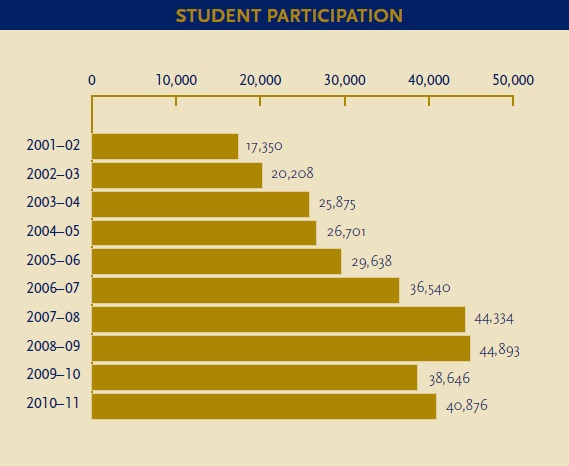
Pennsylvania has one scholarship tax credit program that serves more than 40,000 students.

2011 Results
  • Number of School Choice Programs: 1
  • Total Number of Students: 40,879
  • Total Number of Participating Schools: Not Available
  • Total Expenditures: $48,242,880
Educational Improvement Tax Credit

2011-12 School Year Data Update
  • Scholarships Awarded: 40,879
  • Schools Participating: Not Available
  • STOs Operating: 234
  • 2011 Expenditures: $48,242,880
    Growth in Student Participation

2012 Outlook
Pennsylvania is on the cusp of enacting strong school choice legislation.  Last session, the Senate passed legislation expanding the state’s scholarship tax credit program and enacting opportunity scholarships for students from low-income families that are stuck in failing schools.  Governor Corbett is committed to making school choice a legislative priority and the state’s legislature will continue to debate school choice in 2012.

- American Federation for Children | Alliance for School Choice, MSG